musenelectric.com
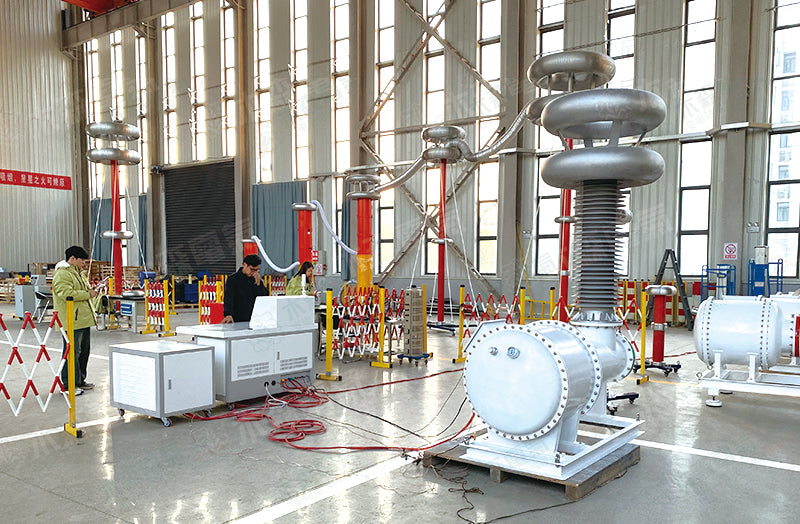
YDQW 50kVA 250kV Partial discharge-free test transformer
YDQW 50kVA 250kV Partial discharge-free test transformer
Couldn't load pickup availability
Partial discharge-free test transformers are primarily used to assess the insulation performance of power equipment (such as high-voltage transformers, cables, and instrument transformers) during factory testing and handover acceptance. By providing a testing environment with extremely low background noise, they ensure that the equipment under test will not experience discharge failures caused by hidden internal insulation defects during long-term high-voltage operation, thereby safeguarding the overall safety and reliability of the power system.
They are mainly used to conduct insulation withstand voltage tests on power equipment with rated voltages of 110 kV and below, including 110 kV power transformers, Gas-Insulated Switchgear (GIS), high-voltage instrument transformers, long-distance high-voltage cables, suspension insulator strings, and high-voltage bushings.
Partial discharge-free power frequency withstand voltage test equipment is an essential testing device for power equipment inspection. With the development of my country's power industry, the requirements for voltage levels and partial discharge of test transformers are becoming increasingly stringent. Traditional oil-immersed test transformers are increasingly unable to meet the requirements of on-site testing in terms of size, weight, and partial discharge capacity.
With the application of new materials and processes, SF6 gas, with its excellent insulation and arc-extinguishing properties, is widely used as a new insulating medium.
Through years of continuous research and development, our company has successfully developed the SF6 series test transformers. Compared with traditional oil-immersed test transformers, this series is 20% to 60% lighter (depending on voltage and capacity levels), produces no oil pollution, achieves a partial discharge capacity of ≤3pC, and can handle voltage levels up to 1200KV per unit. Due to the adoption of low-voltage reactor compensation technology, the current on the 380V power supply side can be reduced by 60%, greatly facilitating user testing. It is particularly suitable for use by provincial and municipal power supply companies, large industrial and mining enterprises, research institutes, and universities.
Product Features:
1. Strong arc extinguishing ability and strong insulation performance
2. Fireproof, non-flammable gas, intrinsically safe
3. Lightweight and highly integrated structure, integrating a gas-filled test transformer, coupling capacitor, current-limiting resistor, and voltage divider into one unit
4. Convenient transportation and installation, small footprint
5. Clean, oil-free, and maintenance-free (only requires periodic monitoring of gas pressure and density)
6. Unaffected by environmental factors, fully sealed within a metallic environment.
Traditional systems, with current-limiting resistors, coupling capacitors, and voltage dividers, have a total discharge of approximately 10pC;
Integrated systems, with built-in current-limiting resistors, coupling capacitors, and voltage dividers, have a total discharge of approximately 5pC.
Technical parameters of the device:
(1) Rated capacity: 50kVA;
(2) Input power: Single-phase 380V, frequency 50Hz;
(3) Rated voltage: 250kV;
(4) Rated current: 0.2A;
(5) Operating frequency: 50Hz;
(6) Output waveform: Sine wave;
(7) Waveform distortion rate of the complete device: ≤5%;
(8) System noise level: ≤65dB;
(9) Transformer short-circuit impedance: ≤6%;
(10) Operating time: 30 minutes continuously under rated voltage and current; 1 minute under 1.1 times overvoltage;
(11) Partial discharge level of the complete device: Rated voltage ≤5pC;
(12) Protection of the test system:
(a) The effect of overvoltage generated on the test transformer during the discharge of the test sample should be considered in addition to configuring a suitable protective resistor in the high-voltage circuit, and other protective measures should also be taken.
(b) Overcurrent protection devices with tail current and other effective protection devices should be used on the high-voltage side.
Share